Sidechain
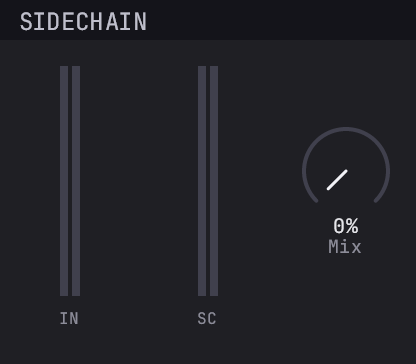
Reference for wiring a separate sidechain input bus. Declares a stereo Main input, a stereo Sidechain input, and a stereo output; meters both input levels and blends them with a Mix knob, so the routing is easy to verify by eye (the meters) and ear (the blend).
Source: examples/truce-example-sidechain/.
#What it demonstrates
BusLayout::with_sidechain_inputto declare a second input bus the host surfaces as a real sidechain (akBusType_Auxbus on VST3, a CLAPis_sidechainport, extra VST2 pins, Pro Tools' mono side-chain on AAX)- Flat channel indexing across buses:
input(0)/(1)is main L/R,input(2)/(3)is sidechain L/R, in declaration order - Detecting an unconnected sidechain with
buffer.num_input_channels()and gating the reads (the wrapper hands unconnected sidechain channels silence, so it never panics) buffer.io_pair(in_ch, out_ch)to read one input channel while writing one output channel in the same loop- Block-constant smoothing with
read_after(buffer.num_samples()), which advances theexp(10)smoother across the whole block so the blend settles in ~10 ms rather than ~10 blocks - Metering both buses into
MeterSlots drawn side by side in the built-inGridLayouteditor
#Parameters
| Name | Range | Unit |
|---|---|---|
| Mix | 0 to 1 (default 0) | % |
At Mix 0 you hear the main input; at 1, the sidechain.
#Testing the routing
Without a host, drive the sidechain from a file with the standalone
runner: --sidechain-file <path>, independent of the main
--input-file (see standalone). In a DAW,
route another track into the plugin's sidechain bus and watch the SC
meter follow it.