Fundsp Reverb (Worker variant)
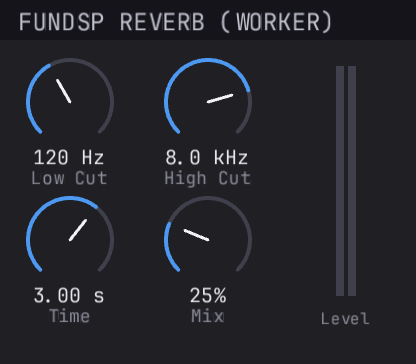
Stereo plate reverb wired through a
fundsp audio graph. The
point of this example is the integration shape — how to hold a
fundsp graph inside a truce plugin and keep it alloc-free on the
audio thread.
This is the production-pattern variant: graph rebuilds run on truce's managed background-task pool and the audio thread picks up the result via a lock-free swap. For the simpler inline-rebuild version (rt-unsafe but easier to read top-to-bottom), see fundsp-reverb-simple. Both crates share the same topology, params, and signal flow.
Source: examples/truce-example-fundsp-reverb-worker/.
The fundsp integration guide walks through both variants in depth.
in (L,R) ──► high-pass (low cut)  ──► low-pass (high cut)  ──► reverb_stereo ──┐
                                                                                │
in (L,R) ─────────────────────────────────────────────────────────────────► dry ┤──► out
                                                                                │
mix ──────────────┘| Param | Range |
|---|---|
| Low Cut | 20 Hz → 2 kHz (log) |
| High Cut | 500 Hz → 18 kHz (log) |
| Time | 0.1 s → 20 s (log) |
| Mix | 0 → 1 |
#Integration patterns
- Graph built off the audio thread.
reset()builds the initial graph synchronously (host calls it off the audio path); subsequent rebuilds run on truce's managed background-task pool.process()never allocates, never callsBox::new, never callsgraph.allocate(), and never drops aBox<dyn AudioUnit>. - Managed rebuild + lock-free handoff. The rebuild is a
BackgroundTasktask:process()posts the latest target withspawn_coalescing(wait-free, newest wins) and the pool runs the handler off-thread. Twocrossbeam_queue::ArrayQueues carry the graphs themselves:ready(worker → audio, the freshly-built graph) anddiscard(audio → worker, so the old graph is dropped off-thread). The pool owns the thread and its wakeup, so there's nopark/unparkorDropjoin to write. - Rebuilds carry their SR. Each ready graph is tagged with the
sample rate it was built for. If
reset()swaps in a new SR while a rebuild is in flight, the audio thread sees the SR mismatch and reroutes the stale graph to the discard queue rather than swapping it in. - Params reach the graph through
fundsp::Sharedatomics.var(&shared)reads them per sample; the closure insidefor_each_stereo_framewrites the smoothed truce-side value into the cell on the same tick (sample-accurate automation). Box<dyn AudioUnit>for the field type. The concreteAn<…>is hundreds of chars of nested generics; the vtable cost is one indirection per block.AudioBuffer::for_each_stereo_frametransposes truce's per-channel layout into stack-allocated 2-in/2-out frames so fundsp'stick(in, out)callback can be called directly. It's the(2, 2)shorthand forfor_each_frame_io::<IN, OUT>, so the same call runs over any declared bus (a mono source fans into both graph inputs, a stereo bus maps 1:1) with no per-width branch. No scratch field.- Reverb time schedules a rebuild task when the param drifts
≥ 5% —
reverb_stereo'stimeargument is baked at construction. The audio thread reads the rawparam.value()(not the smoothed.read()) so a knob ramp doesn't trip the threshold every block while the smoother crawls across it.
#Gotchas
- Filter input order is positional and unchecked.
highpass()/lowpass()take(signal, cutoff, Q). Every connection isf32, so(cutoff | Q | signal) >> highpass()compiles fine and silently feeds the filter cutoff in as audio — the resulting filter blows up the reverb FDN to peak ~7000 within a second. Test against constant input +assert_peak_below. - Type-level channels.
dry * mixfails to compile whendryis stereo andmixis a 1-channelSharedread; broadcast the mix to stereo manually withvar(&mix) | var(&mix). fundsp's payoff (graph composition with>>/|/&) costs this kind of explicit plumbing.